Trump Signs EO on Regenerative Agriculture While EPA Approves More Toxic Forever Chemicals
This article first appeared in the August 2026 issue of Presence Marketing’s newsletter.
By Steven Hoffman
The summer of 2026 has delivered a dizzying regulatory whiplash for the natural, organic, and regenerative agriculture industry. On one hand, the phrase "regenerative agriculture" has officially reached the highest echelons of federal policy, recently enshrined in a presidential executive order and championed loudly under the populist "Make America Healthy Again" (MAHA) banner.
On the other hand, a quiet but aggressive rollout of toxic synthetic "forever chemicals," deep cuts to public health and agricultural inspection funding, and sweeping executive and legal victories for the agrochemical lobby tell a starkly different story.
For business owners, executives, and retailers in the natural and organic products sector, this legislative and regulatory environment presents a highly volatile mixed bag. We are witnessing a fundamental tension between the administration's public health rhetoric and its actual regulatory execution. As consumers increasingly look to the natural channel for transparency and safety, understanding these seismic shifts is critical.
Here is a comprehensive look at how recent federal actions, courtroom reversals, and public health fallouts are redefining the business of food and agriculture from the soil to the shelf.
The Biofuel Pivot: Is It True Regenerative Agriculture?
On June 25, 2026, President Donald Trump signed Executive Order 14414, formally titled Advancing Regenerative Agriculture and Strengthening American Farm Resilience. The directive instructs the U.S. Department of Agriculture (USDA), the Environmental Protection Agency (EPA), and Health and Human Services (HHS) to expand precision farming, streamline agricultural innovation, and evaluate cumulative chemical exposures in the food supply.
Simultaneously, USDA Secretary Brooke Rollins introduced a final Regenerative Feedstock Rule. Rather than injecting expansive new government subsidies into direct federal conservation or organic transition programs, the administration’s approach is entirely market-driven. As detailed by the Western Ag Network, the new USDA framework ties directly into the 45Z Clean Fuel Production Tax Credit, utilizing an updated "Feedstock Carbon Intensity Calculator" to connect on-farm practices with biofuel supply chains.
In practice, this allows massive conventional corn, soybean, and sorghum producers to document specific farming practices—such as no-till or cover cropping—and market their harvests at a premium to ethanol and biofuel producers. The goal is to incentivize carbon reduction without imposing federal mandates.
While market-based incentives for carbon reduction sound promising, advocates and organic farmers are raising the alarm. Many view this framework as a blatant co-opting of the regenerative movement by Big Ag. True regenerative agriculture—as pioneered by the organic movement—focuses on eliminating toxic inputs, restoring biodiversity, and building soil health to grow nutrient-dense food. Critics argue that the administration is simply repackaging the term "regenerative" into a carbon-scoring mechanism to subsidize industrial biofuel production, all while continuing to allow the use of synthetic pesticides and fertilizers on those very same crops. For natural products retailers, this underscores the urgent need to differentiate true regenerative organic food from conventional crops participating in carbon tax credit programs.
Funding Volatility and a Courtroom Rebuke
This pivot toward corporate biofuel subsidies has been accompanied by aggressive cuts to programs meant to support small-scale and marginalized farmers.
The administration’s new executive order did not add net-new financial outlays; rather, it shifted approximately $700 million within existing agency budgets to fund its new pilot programs. To balance the books and fulfill a mandate to eliminate what it deemed wasteful spending and "diversity, equity, and inclusion (DEI)" initiatives, the USDA abruptly canceled the Increasing Land, Capital, and Market Access Program (ILCMA) earlier this year. Originally a $300 million initiative to help Black, Native American and historically underserved farmers secure land and financing, the program was canceled earlier this year over alleged administrative and DEI-related concerns.
However, the administration’s aggressive funding cuts recently hit a major legal wall. On June 30, U.S. District Judge Beryl Howell granted a preliminary injunction ordering the USDA to restore $127 million in canceled grants to 24 organizations while litigation continues. The plaintiffs successfully argued that the USDA unlawfully terminated the awards based on arbitrary keyword searches rather than on performance or merit. This courtroom rebuke is a massive victory for grassroots agricultural groups and reinforces the USDA's legal obligation to honor its contracts with the young and first-generation farmers who represent the future of the nation’s specialized food supply.
In another piece of rare, positive news for the natural products sector, the USDA recently announced that the organic certification cost-share funds have finally been released. These funds are a vital lifeline for small- to mid-sized organic operations, reimbursing them for a portion of the financial burden required to maintain their rigorously audited USDA Organic certifications. The release of these funds will help stabilize the organic supply chain as farmers finalize their operational budgets for the coming year.
#ChemGate and PFAS Proliferation
While the administration touts its commitment to farm resilience, its environmental regulatory arm is moving in a dangerously contradictory direction.
In early July 2026, the EPA quietly fast-tracked the approval of three new toxic pesticides containing PFAS (per- and polyfluoroalkyl substances)—commonly known as "forever chemicals." The hazardous new herbicides—trifludimoxazin, diflufenican, and epyrifenacil—can now be sprayed directly on major food crops, including wheat and citrus. According to the Environmental Working Group (EWG), EPA scientists themselves flagged one of these chemicals as having "suggestive evidence of carcinogenic potential."
This decision brings the total number of PFAS pesticides greenlit by the current EPA to five in under two years. These chemicals do not break down in the environment; they accumulate in the soil, the water table, and ultimately, the human bloodstream, where they are linked to immune system suppression and severe reproductive health issues.
The regulatory failure extends to the FDA, which recently refused a formal petition to set strict limits on forever chemicals in food, leaving consumers entirely unprotected from the downstream effects of the EPA's pesticide approvals.
Food industry visionary and financial analyst Robyn O’Brien has aptly dubbed this crisis "#ChemGate." O'Brien warns that when regulatory bodies become hopelessly captured by the chemical lobbying arms they are meant to oversee, the entire integrity of the American food supply collapses. For natural products retailers, the EPA's quiet unleashing of forever chemicals onto conventional produce serves as the ultimate marketing imperative for the organic seal. As conventional agriculture becomes increasingly saturated with indestructible synthetic toxins, the rigorously audited, “no toxic synthetic pesticides” promise of the organic aisle transforms from a premium lifestyle choice into a fundamental public health necessity.
The Glyphosate Betrayal: A Fracture in the MAHA Alliance
The tension between the populist MAHA movement and the administration’s actual policy execution reached a breaking point this year over the world’s most notorious herbicide: glyphosate.
The fracture began in February 2026 when President Trump issued an executive order invoking the Defense Production Act to mandate and protect the domestic production of glyphosate (the active ingredient in Roundup), citing national security and food supply chain resilience. The order granted broad liability immunities, infuriating MAHA advocates who had championed the administration on the promise of health reform. As Environmental Working Group President Ken Cook noted at the time, the move was viewed by many wellness advocates as a "direct assault" on the MAHA platform and a great gift to the chemical lobby.
This administrative protection was recently compounded by a landmark decision from the nation's highest court. This summer, the U.S. Supreme Court ruled in favor of agrochemical giant Bayer regarding its glyphosate-based weedkiller. The ruling effectively blocks thousands of state-level "failure-to-warn" lawsuits, determining that federal EPA label approvals preempt state laws that might otherwise require cancer-warning labels on toxic pesticides.
This decision essentially grants a liability shield to pesticide manufacturers, protecting them from plaintiffs alleging they were not properly informed about the severe health risks associated with chronic glyphosate or other chemical pesticide exposure.
For the MAHA movement, the executive protections and the Supreme Court ruling exposed a deep rift between the political rhetoric of "making America healthy" and a regulatory reality that actively insulates the chemical agriculture industry from legal consequence. As reported by Grist, attempts to appease MAHA's fury over the Roundup rulings have largely backfired, leaving health-freedom advocates feeling profoundly betrayed. Protests have taken place outside the Supreme Court, signaling that the coalition of health advocates that helped propel the administration into office is fracturing over its failure to regulate Big Chem.
The Public Health Fallout: The Cost of Cutbacks
The consequences of prioritizing corporate deregulation and cutting federal research and inspection budgets are not abstract; they are already playing out in real time across the nation's supply chains and emergency rooms.
The current administration has initiated historic cutbacks in public health funding, FDA food inspections, and USDA agricultural research. The result is a regulatory apparatus that is operating with severe blind spots, and the public is paying the price.
In recent weeks, an explosive food-borne Cyclospora outbreak has swept across the United States, causing severe, prolonged gastrointestinal illness. Cyclospora is a microscopic parasite transmitted through feces and typically linked to contaminated fresh produce. As of July 2026, the parasite has sickened thousands of Americans across at least 34 states, with the Midwest bearing the brunt of the crisis. In Ohio, the Cleveland Clinic reported a staggering jump in lab testing, skyrocketing from just one test per day to nearly 200 as symptomatic patients flooded local hospitals.
The federal response has been heavily hindered by recent agency rollbacks. Due to severe staffing shortages and budgetary cuts at the Centers for Disease Control and Prevention (CDC)—which recently made the tracking of certain foodborne illnesses optional—federal case data has drastically lagged behind real-time state-level reporting. Without a robust, centralized federal tracing apparatus, state health investigators have been left to piece together the puzzle on their own. While early interviews strongly point to lettuce and salad greens as the leading suspected source, a specific grower, brand, or supplier has yet to be definitively named by federal authorities.
As local health departments scramble to track the outbreak's expanding footprint across the country, this unresolved crisis raises grave questions about the ability of gutted federal agencies to adequately monitor the safety of the conventional food supply. When the government can no longer proactively track and trace a pathogen, the burden of food safety falls entirely on the retailer and the private supply chain.
Simultaneously, the agricultural sector is battling a devastating screwworm outbreak affecting livestock. For decades, the USDA successfully managed the threat of the New World screwworm—a parasite that feeds on the living tissue of warm-blooded animals—through robust research and sterile insect release programs. However, recent reductions in federal research funding and the mass exodus of USDA researchers who are refusing mandatory relocations have compromised the agency's ability to maintain these critical biological defense lines, resulting in a crisis for ranchers and a direct threat to the meat supply chain.
The Strategic Path Forward for the Natural Channel
As we survey the current landscape, the mandate for the natural, organic and regenerative products industry is unmistakably clear. We can no longer rely on federal tailwinds, government definitions, or public safety nets to protect our consumers or our food supply.
When the federal government co-opts the term "regenerative" to subsidize industrial biofuels, unleashes PFAS forever chemicals onto conventional crops, shields glyphosate manufacturers from liability, and defunds the agencies responsible for keeping parasites out of our produce, the conventional food system ceases to be a safe default for the American family.
In this environment of deep institutional failure, the natural products channel stands as the last line of defense.
Retailers, brands and investors must step into the regulatory void and double down on uncompromising transparency. We have an opportunity to educate customers on the profound difference between a federally subsidized "regenerative" biofuel crop and rigorously audited USDA Certified Organic and Regenerative Organic Certified (ROC) food systems.
Furthermore, private capital must continue to step forward. To truly scale clean agriculture, the private sector needs to prioritize funding the organic transitions, the local supply chain infrastructure, and the independent agricultural research that the federal government is actively abandoning.
The agricultural policies of 2026 are indeed a mixed bag—heavy on chemical appeasement and light on actual public health reform. But out of this chaos emerges a profound opportunity. As the conventional system compromises itself, the value proposition of the natural, organic, regenerative, and specialty food industry has never been more vital, more distinct or more essential to the future of human health and environmental resilience.
Steven Hoffman is Managing Director of Compass Natural Marketing, a strategic communications and brand development agency serving the natural and organic products industry. Learn more at www.compassnatural.com.
Industry Leaders Respond to USDA’s Funding Announcement for Regenerative Agriculture
This article first appeared in the January 2026 issue of Presence Marketing’s newsletter.
By Steven Hoffman
U.S. Secretary of Agriculture Brooke Rollins, alongside U.S. Health and Human Services (HHS) Secretary Robert F. Kennedy, Jr., and Centers for Medicare & Medicaid Services Administrator Mehmet Oz, M.D., on December 10 announced a $700 million Regenerative Pilot Program to help American farmers adopt practices that improve soil health, enhance water quality, and boost long-term productivity, all while building a healthier, more resilient food system, said USDA. According to the release, HHS also is investing in research on the connection between regenerative agriculture and public health, as well as developing messaging to explain this connection.
“Protecting and improving the health of our soil is critical not only for the future viability of farmland, but to the future success of American farmers. In order to continue to be the most productive and efficient growers in the world, we must protect our topsoil from unnecessary erosion and improve soil health and land stewardship. Today’s announcement encourages these priorities while supporting farmers who choose to transition to regenerative agriculture. The Regenerative Pilot Program also puts farmers first and reduces barriers to entry for conservation programs,” said Secretary Rollins.
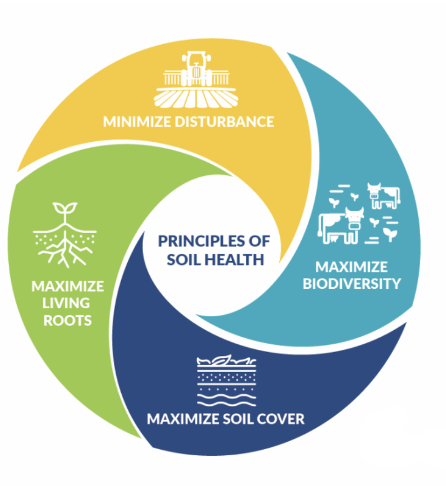
Administered by USDA’s Natural Resources Conservation Service (NRCS), the new Regenerative Pilot Program is designed to deliver a streamlined, outcome-based conservation model—empowering producers to plan and implement whole-farm regenerative practices through a single application. In FY2026, the Regenerative Pilot Program will focus on whole-farm planning that addresses every major resource concern—soil, water, and natural vitality—under a single conservation framework. USDA said it is dedicating $400 million through the Environmental Quality Incentives Program (EQIP) and $300 million through the Conservation Stewardship Program (CSP) to fund this first year of regenerative agriculture projects. The program is said to be designed for both beginning and advanced producers, ensuring availability for all farmers ready to take the next step in regenerative agriculture.
To support the program, NRCS is establishing a Chief’s Regenerative Agriculture Advisory Council “to keep the Regenerative Pilot Program grounded in practical, producer-led solutions,” USDA said. The Council will meet quarterly, with rotating participants, to advise the Chief of NRCS, review implementation progress, and help guide data and reporting improvements. Its recommendations will shape future USDA conservation delivery and strengthen coordination between the public and private sectors.
USDA also said it is permitting public-private partnerships as part of the Regenerative Agriculture Initiative (RAI), claiming that such partnerships will allow USDA to match private funding, thus stretching taxpayer dollars further, and bringing new capacity to producers interested in adopting regenerative practices.
We asked leaders in regenerative agriculture to weigh in on USDA’s announcement. Here’s what they had to say:
Hannah Tremblay, Policy and Advocacy Manager, Farm Aid
As a strong supporter of regenerative agriculture, Farm Aid welcomes USDA’s funding announcement for regenerative agriculture, but the lack of details about the program's specifics means we're unable to give a full response or analysis. From the few details that have been provided to date, this looks like a streamlining of processes and possible restructuring of existing funding, but does not appear to represent new funding for these programs.
The chronic underfunding and oversubscription of the EQIP and CSP programs – two crucial conservation programs – are ongoing problems that this administration and Congress have not addressed. The recent budget bill passed by Congress makes it easier for large operations to disproportionately use EQIP and CSP dollars by removing payment limits and Adjusted Gross Income (AGI) requirements. Policies like these make these programs less accessible to small and diversified farming operations and do a disservice to family farmers who are trying to enact conservation practices.
This sudden embrace of regenerative agriculture flies in the face of the other policies we've seen from this administration, including canceling the Climate Smart Commodities Program, EPA's fast tracking of pesticides and cuts to USDA's NRCS staff, who are crucial to helping farmers implement soil health practices.
Matthew Dillon, Co-CEO, Organic Trade Association
There are still many details to come in the implementation of the NRCS regenerative program, but the Organic Trade Association (OTA) is always supportive of programs that help farmers transition to improved management of their natural resources. It would appear that it will give farmers an à la carte menu of practices that they can select and create a less burdensome bundled approach with NRCS. If we can make it easier for farmers to better care for natural resources, that’s a good outcome.
The optimal outcome would be for farmers to have integrated and holistic conservation plans, like those that organic farmers do in their annual Organic System Plan. And ideally, that would include pesticide mitigation plans for those farmers who are conventional. Hopefully for some of these farmers it will be an on-ramp to exploring opportunities in organic markets.
At the end of the day, policy incentives will only go so far in rewarding farmers for ecosystem services – markets and consumers are essential. Organic is the only third party, verified, backed-by-law marketplace that does that. We will work to make sure organic farmers have adequate access and get recognition in these programs.
Ken Cook, Executive Director, Environmental Working Group
Basically, I’m pretty skeptical of the Regenerative Pilot Program. If you look at all of Robert F. Kennedy, Jr.’s big talk during the Trump campaign and then during the transition regarding subsidies, $700 million rebranded from existing programs (with multi-billion-dollar budget baselines that a lot of us built and defended) is hardly the bold action he promised. The emphasis on efficiency and red tape is interesting—whole farm plans that originated in the 1930s and 1940s in the old Soil Conservation Service (SCS) are all about paperwork and red tape, and going back, a lot of us in the conservation world (and reformist elements within NRCS) pushed the agency to focus on practices aimed at priority lands/problems. Reformers in NRCS in the 1980s and after always felt whole-farm plans were make-work that resulted in career advancements (and documents on farmers’ shelves) but not necessarily conservation on the ground.
There was no emphasis at the press conference announcing the program on reducing pesticides. Nor was there any emphasis on aiming some of the money at organic, the only system out there that does fulfill the MAHA rhetoric from farm to grocery shelf.
And of course, during the Biden administration there was so much emphasis in regenerative circles on climate progress via carbon farming, carbon sequestration, farmers selling carbon credits, and so on, but those words and objectives have been forbidden by USDA. (We always thought the carbon stuff was way oversold—and not needed to justify lots of benefits from mixed crop-livestock farms, longer more diverse rotations, cover crops and other sensible practices that…have also been around and under-deployed by farmers since the 1930s despite BILLIONS spent by taxpayers on free technical assistance and cost-sharing).
Then of course there are the ‘antithesis-of-MAHA’ cuts to vital programs earlier this year to get local food to schools and food banks, the reductions in NRCS staff to do those whole-farm plans, and the massive, multi-billion-dollar subsidies that have been paid in tariff reparations to big commodity operations—whose payment limits have been generously increased to make sure the biggest operations get the most money.
Christopher Gergen, CEO, Regenerative Organic Alliance
The Regenerative Organic Alliance (ROA) welcomes the USDA’s announcement of a new Regenerative Pilot Program as an important signal of federal commitment to advancing healthier soils, more resilient farms, and stronger rural economies. We applaud this growing recognition that agriculture must go beyond extraction toward restoration, a core belief that has guided our work since the creation of the Regenerative Organic Certified® (ROC™) standard.
As USDA begins shaping the program’s criteria and implementation, ROA encourages alignment with the rigorous, holistic principles that define regenerative organic agriculture: improving soil health, ensuring dignified and fair conditions for farm workers, and supporting the humane treatment of animals. These three pillars are foundational to the ROC framework and have proven essential to achieving long-term ecological, economic and community benefits.
We are encouraged that the USDA acknowledges the role of organic systems in regenerative agriculture. ROC builds on USDA Organic as a necessary baseline for eliminating toxic synthetic pesticides, fertilizers, and GMOs — inputs that undermine soil biology, water quality, pollinator health, and farmworker safety. ROC then goes further by requiring additional soil health practices, pasture-based animal welfare, and fair labor conditions.
As decades of peer-reviewed research and field evidence show, regenerative practices alone cannot fully deliver intended environmental outcomes if they allow routine use of synthetic chemicals. The scientific record also shows that organic systems, including those that strategically use tillage for weed control in lieu of herbicides — consistently build soil carbon, increase water retention, reduce erosion, and improve microbial diversity. We encourage USDA to ensure that any regenerative agriculture program reflects this evidence by prioritizing systems that avoid toxic inputs and protect both ecological and human health.
The rapid expansion of regenerative claims creates both opportunity and risk. Without clear definitions, rigorous standards, and third-party verification, the regenerative category is vulnerable to greenwashing and consumer confusion. Independent analysis has shown that some non-organic regenerative labels allow herbicides, GMOs, synthetic fertilizers, and minimal verification, which could undermine public trust and the credibility of the entire regenerative movement.
With the right structure, USDA’s initiative can accelerate the transition to a food and fiber system that heals the land, strengthens rural communities, and ensures a healthier future for all; a vision that drives our mission every day. ROA looks forward to engaging with USDA as this pilot advances and to contributing our expertise, data, and proven frameworks to help shape a regenerative future rooted in integrity, transparency, and meaningful impact.
Jeff Tkach, Executive Director, Rodale Institute
Rodale Institute welcomes the USDA’s announcement of the new Regenerative Pilot Program and views it as an important signal that soil health, farm resilience, and long-term productivity are increasingly central priorities within American agriculture. This moment reflects a growing federal recognition that healthy soil is foundational to a secure food system, climate resilience, and human health.
For more than 78 years, Rodale Institute has led the science and practice of regenerative organic agriculture, long before “regenerative” entered the policy lexicon. Through the longest-running side-by-side comparison of organic and conventional farming systems in North America, Rodale Institute has demonstrated that regenerative organic agricultural practices can improve soil health, enhance water quality, increase resilience to extreme weather, and support farm profitability.
With a national network of research hubs, education initiatives and farmer training programs, Rodale Institute has helped producers across regions and production systems transition to regenerative organic practices rooted in measurable outcomes and continuous improvement. This experience, coupled with our leadership as a founding member of the Regenerative Organic Alliance, positions Rodale Institute as a critical partner in ensuring that regenerative initiatives are clearly defined, science-based, and deliver real, lasting benefits for farmers, communities, and the environment.
As the USDA advances this pilot program, Rodale Institute stands ready to contribute its decades of research, farmer-centered expertise, and leadership to help guide its success. By keeping soil health at the center of agricultural policy and practice, we can continue building a food system that supports productive farms, nourishing food, and healthy people, now and for future generations.
Paige Mitchum, Executive Director, Regen Circle
This Regenerative Agriculture Pilot Program is not new. It is a carve-out from the existing Farm Bill’s conservation funds using the same forms, rankings and field offices. The key difference is that they were processing proposals differently. Under the Climate Smart Commodities Program the process went USDA ↔ big project ↔ farmer. This pilot now routes money through individual NCRS contracts so the process flows as NRCS ↔ farmer. This sounds cleaner unless the agency in the middle just lost 20% of its staff, as is the case with the NRCS.
By doing away with the big projects intermediaries you lose the support provided by states, tribes and NGOs whose role was to recruit farmers, do measurement verification and reporting, provide technical assistance and handle smaller payments. Without this the NRCS will need significantly more bandwidth to handle a direct to farmer approach. But they aren’t staffing up; the FY2026 plan indicated further personnel reductions, leaving me to draw only one conclusion: The regenerative pilot program will be woefully under resourced, forcing them to accept applications from large well-resourced operations leaving small and vitally important producers on their own.
In a nine‑day window in December, the administration: backed pesticide maker Bayer in court, poured billions into the most glyphosate‑dependent crop systems, and then unveiled a sub‑billion-dollar regenerative agriculture pilot program as its health‑and‑soil solution. Once again this administration has brilliantly cut social infrastructure and meaningful programs that were supporting small farmers in regenerative transition, shielded a flagship herbicide company from liability, bailed out large monocultures, and in exchange handed us a small carve-out of existing programs with zero new infrastructure or any credible way of executing said program. As such, this reads more as a marketing scheme than it does meaningful policy work, and I hope that the private sector can step up and support the small holder farmers at the heart of the regenerative movement.
They took away the mountain we were slowly, imperfectly but intentionally building, they took a shovel and put a small mound of dirt aside and said, take this and enjoy the view.
Read Page’s full article here.
André Leu, D.Sc., BA Com., Grad Dip Ed., International Director, Regeneration International
In theory, this is a great initiative. Improving soil health through regenerative practices has been long overdue. Most farmers, including many organic farmers, need to adopt these methods. In reality, it will depend on who is selected to sit on the Chief’s Regenerative Agriculture Advisory Council. If it is composed of regenerative and organic farmers, it will be credible. If they repeat the NOSB (National Organic Standards Board) model, it will be hijacked by academics, NGOs and agribusiness. It will be an exercise in greenwashing, promoting no-till Roundup-ready GMOs and other degenerative practices. I don't have confidence that, given the USDA's history with the organic sector, they will choose the credible option.
Alexis Baden-Mayer, Political Director, Organic Consumers Association
I've been looking into where the money's coming from for the Regenerative Agriculture Pilot Program and how much has been allocated versus taken away. This is money Congress appropriated for two regenerative agriculture programs (the Environmental Quality Incentives Program and the Conservation Stewardship Program) with a total annual budget of $4.515 billion. So, if $700 million is going to regenerative, that means $3.815 billion (84%) of EQIP and CSP funds will be going to factory farms and pesticide-drenched genetically modified field crops. Admittedly, Trump's USDA isn't the first to misappropriate these funds this way, but it is the first to celebrate it.
Earlier this year, the USDA refused to disburse $6.062 billion appropriated by Congress for family famers adopting regenerative agriculture practices and serving local markets. Now we're now supposed to be happy because the USDA is earmarking $700 million for regenerative agriculture? I feel like they're trying to convince us two pennies is more than a dollar bill because two is more than one.
Max Goldberg, Founder, Editor and Publisher of Organic Insider
The USDA's announcement of about $700 million dedicated to regenerative agriculture puts the spotlight on the importance of soil health at a critical time and is extremely welcome. Yet, whether this program can actually deliver tangible results to America's farmland remains a serious uncertainty, and there are two questions that must be answered.
First, does the USDA have adequate on-the-ground technical staff to assist farmers in executing regenerative practices while also measuring soil health improvements? Second, will this program actually lead to a reduction in pesticide use? Only time will tell, but the level of skepticism is very high that the funds will be spent in an efficient manner and this will result in meaningful progress.
Dan Kane, Lead Scientist, MAD Agriculture
The Regenerative Agriculture Initiative (RAI), also called the Regenerative Pilot Program (RPP), is a program announced by Secretary Rollins on Dec. 10, 2025. The press release from USDA describes it as a $700 million pilot program for FY2026 focused on helping farmers transition to regenerative practices.
The RAI is not a new program but instead a repackaging of existing USDA Natural Resources Conservation Service (NRCS) conservation programs, including the Environmental Quality Incentives Program (EQIP) and the Conservation Stewardship Program (CSP). Nor does the RAI designate new funding towards either of these programs and the practices they target. It will likely function as a priority national funding pool producers can apply to with some minor modifications to requirements and the application process. Efforts by the prior administration to increase funding to key regenerative practices and the regenerative agriculture community more broadly through the Inflation Reduction Act (IRA) would have provided greater funding overall in FY2026 and beyond.
The IRA added approximately $19.5 billion into USDA conservation programs above and beyond 2018 Farm Bill funding levels over a period of four fiscal years (FY2023-FY2028). EQIP would’ve been expanded by $8.45 billion over that period, with about $3.45 billion of that coming in FY 2026 for a combined total of $5.5 billion in FY2026. CSP would’ve received $3.25 billion over that period with $1.5 billion coming in FY2026 for a combined total of $2.5 billion in FY2026.
Given all the shifts in funding, and the reallocation of IRA funds to CSP and EQIP baseline spending enacted through the One Big Beautiful Bill Act (OBBB), RAI is effectively funded through the reallocation of IRA funds. But, considering the reduction in total funding, it’s still not net new spending compared to what would’ve happened had IRA stayed in place. Although the OBBB increased baseline EQIP and CSP funding over a longer time period, the Congressional Budget Office still estimates that the rescission and reallocation of IRA funds will result in a net decrease of approximately $2 billion in actual conservation spending through FY2034.
While some of the changes included in this program (bundling applications, whole farm planning, soil testing) are good ideas, they’re ideas that NRCS has already applied through other programs. Major reductions in NRCS staff and proposed changes to how the NRCS is structured are likely to limit total capacity and reduce agency efficiency and function. Last, the elimination of income eligibility caps and the potential integration of public/private partnerships into the program raise concerns that this program and USDA conservation programs writ large will end up primarily serving very large farmers and agribusiness interests.
Any USDA programming focused on regenerative agriculture is a welcome addition to the financial stack for producers. No doubt we at Mad Agriculture will keep this program in mind as a potential option for the producers with whom we work. But this is a small win in comparison to the huge loss that came through the rescission/reallocation of IRA funds.
Read MAD Agriculture’s full analysis of USDA’s Regenerative Agriculture Initiative here.
Charles "Chuck" Benbrook, Ph.D., Founder, Benbrook Consulting Services
Chuck Benbrook is the former Chief Science Officer of The Organic Center; former Research Professor, Center for Sustaining Agriculture and Natural Resources, Washington State University; and former Director, National Academy of Sciences Board on Agriculture
As someone who has been deeply involved in soil conservation policy, I was excited to see this announcement from the USDA Natural Resources Conservation Service (NRCS). With $700 million committed in the next fiscal year, it's a pretty substantial investment in regenerative agriculture. The hope is that it will go on with continued, and hopefully increased, funding.
As I read the announcement for the Regenerative Pilot Program, it seems to be a clear recognition by the USDA that soil health and what is needed to enhance the biological integrity and health of the soil has to be a very high priority. In fact, on par with controlling physical erosion. And I think that's the right direction. That's how we're going to lower the cost of production. That's how we're going to clean up water and start dealing with all these rural areas with ridiculously high levels of nitrate in everybody's drinking water. It's how we're going to deal with resistant weeds. Dealing with soil biology at this point is the most important and lowest hanging fruit for healing what ails us.
I think there are two aspects to the significance of USDA's announcement. One, it recognizes farmers anywhere along the continuum, from conventional, chemical-dependent farmers to regenerative organic producers. Wherever you are along the continuum, if you want to move toward a more diversified, resilient, less chemical-dependent system, you have to make multiple changes simultaneously and timed correctly to succeed.
I also think the NRCS approach of entering into customized contracts with growers that start from where they're at and finance the next round of changes in their farming systems, which could include changes in rotations, tillage, cover crop management and water management, is a good one.
It's also a positive that it's a streamlined administrative process where the farmer basically comes in with a proposal and works with the local NRCS and farm services agency staff to come up with how much the cashier payment will be next year and presumably for subsequent years for the practices that are adopted. Of course, one of the big concerns that people have is how progress is going to be monitored and quantified in a convincing way. Also, like everyone, I'm curious to see the details of how NRCS is going to structure the contracts.
My wish with this program is that smaller producers will have as much access as larger operators, however the fact is, those big commodity farmers tend to get favored when it comes to grants. Yet, I didn't see anything in the announcement to suggest that the NRCS is going to take into account the size of the farm in allocating the available funds. But let's face it, the larger, more sophisticated, often multi-owner, farms are going to be in the door first with well thought out proposals.
Regarding the appointment of an Advisory Council to help oversee the Regenerative Pilot Program, I think (USDA) Secretary Rollins has had a constructive series of conversations with people that come out of the organic and regenerative community. I also think she'll insist that a few folks from that world are on this advisory committee. But, you know, if past is prologue, the soybean growers will have a rep, the cotton council will have a rep and the pesticide industry will have a couple of reps. And it might not be somebody that's working actively for a pesticide manufacturer today, but it could be someone who has deep roots in that community. They may be an academic now. They may work for a consulting firm, but you know, the politics inside these federal agencies is really brutal.
The NRCS regenerative program has great potential to be the fulcrum to start the transition towards more diversified, sustainable regenerative systems, but for it to work in a meaningful way at scale, it has to be combined with a similar negotiated change in how commodity program subsidies and crop insurance subsidies are currently supporting agriculture. And that's the core idea behind what we're working on now called the Farm Economic Viability and Renewal Act, or FEVER Act, to help spark discussion among agriculture community leaders and policymakers of the systemic reforms in policy needed to avoid ever-larger bailouts in the not-too-distant future.
The large sums of taxpayer money at play — over $40 billion in farm support in 2025, and likely even more in 2026 — heighten the urgency of reaching agreement on substantive policy changes. The pressing challenge is to not invest taxpayer dollars during 2026 and beyond in bigger and better band aids, but instead in support of the deeper, systemic changes in farming systems that most farmers, advocates for healthier rural communities, scientists, and policy wonks know are needed.
Companies interested in partnering with USDA NRCS in the Regenerative Pilot Program can email regenerative@usda.gov for more information. Farmers and ranchers interested in regenerative agriculture are encouraged to apply through their local NRCS Service Center by their state’s ranking dates for consideration in FY2026 funding. Applications for both EQIP and CSP can now be submitted under the new single regenerative application process.
Steven Hoffman is Managing Director of Compass Natural Marketing, a strategic communications and brand development agency serving the natural and organic products industry. Learn more at www.compassnatural.com.
From Startups to Multinationals, Regenerative Agriculture Reshapes the Food Business
By Steven Hoffman
As climate change accelerates, the food industry faces a paradox: It is both a driver of ecological degradation and a potential solution. Agriculture accounts for about a quarter of global greenhouse gas emissions, yet it also has the capacity to sequester carbon and rebuild ecosystems. At the center of this opportunity sits regenerative agriculture – a set of practices that go beyond “sustainable” to actively rebuild soil, restore biodiversity, and promote community health and the health of local economies.
In business terms, regenerative agriculture is moving from philosophy to label. Much as “organic” transformed consumer expectations in the 1990s and early 2000s, “regenerative” is quickly becoming one of the fastest-growing claims appearing on food and beverage products. Retailers, too, are beginning to carve out shelf space for regenerative brands, echoing the early days of organic.
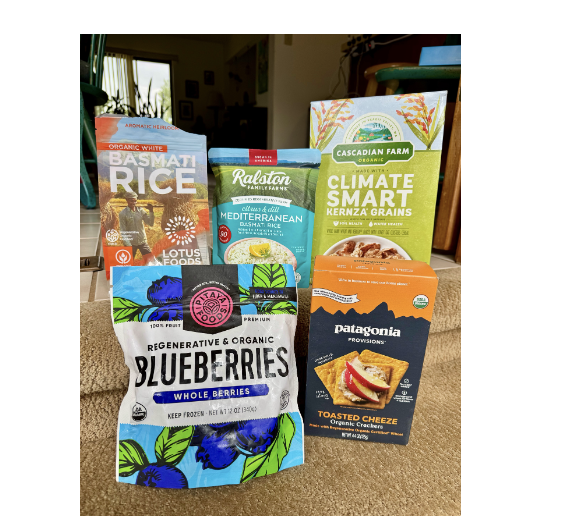
The rise of regenerative can be attributed in great part to the fact that, according to GLOW/NielsenIQ surveys, 70% of consumers consider environmental responsibility more important than they did just two years ago, and 90% see eco-friendliness as a key decision criteria. Over 78% of consumers aged 18-24 believe the current food system is not sustainable and is a major cause of the climate crisis, reported Errol Schweizer on Sept. 22, 2025, in Forbes.
For companies across the value chain – from Roaring Fork Mill, a family-run mill working to restore heirloom grain farming in the Rocky Mountain West, to Lundberg Family Farms, which recently converted all of its organic rice production to Regenerative Organic Certified, and to multinationals including McDonald’s, PepsiCo, General Mills, Nestlé, and others – adopting regenerative practices represents not just climate responsibility, but it also gives them a competitive edge in a changing marketplace.
What Regenerative Agriculture Means
The concept of regeneration is not new. Farmers and Indigenous communities have practiced soil-restoring methods — such as cover cropping, crop rotation, and integrated livestock management — for centuries. What distinguishes modern regenerative agriculture, as coined by Robert Rodale in the late 1970s, is its intentional framing as a climate strategy, ecosystem rebuilder, and market driver.
At its core, regenerative agriculture refers to farming and grazing practices that restore soil health, increase biodiversity, improve water cycles, and strengthen the resilience of agricultural regions. These practices, which vary according to crop, climate, and ecosystem, are helping to rebuild soils, sequester carbon, and revitalize farming communities. While not all regenerative standards are based on organic principles, many proponents argue that organic remains a baseline for regenerative practices.
The Regenerative Organic Certified (ROC) standard, launched by the Regenerative Organic Alliance (ROA) in 2017, represents the most rigorous framework for these practices worldwide. Unlike other regenerative programs, ROC prohibits the use of synthetic pesticides and fertilizers, which the organization asserts contribute to the climate crisis. ROC certification includes requirements for practices that respect animal welfare and promote social fairness.
The results are becoming measurable. According to industry data released by ROA in September 2025, ROC practices now span nearly 20 million acres across 46 countries, involving more than 67,000 smallholder farms and 320 participating brands.
From Niche to Mainstream: Market Momentum
Consumer demand is pushing regenerative agriculture into the mainstream. Products carrying the ROC label have grown 45% year-to-date, with retail sales up $20 million, representing a 24% jump over the previous year, according to ROA. Such growth is remarkable given that regenerative certification is relatively new, and it demonstrates that consumer appetite for climate-friendly products extends beyond niche markets, according to the organization.
Several pioneering brands working with the Regenerative Organic Alliance illustrate how regenerative claims are translating into market share:
- Dr. Bronner’s, the natural soap leader, has worked with more than 18,000 smallholder farmers to convert 52,000 acres to ROC standards.
- Lundberg Family Farms, known for its California-grown rice, has transitioned all of the organic rice it grows to ROC. The company reports that 65% of its consumers actively seek ROC products, creating clear market differentiation.
- Applegate, a leader in organic meats, converted 100% of the beef in its organic hot dogs to ROC in 2025, touching nearly 10 million acres, the company claims. Label research found that adding the regenerative claim increased purchase consideration significantly among hot dog buyers, a signal to CPG marketers that the regenerative label stands out in crowded categories.
- Gallant International, a private-label textiles company, has grown its farmer network from 700 to 1,250 in just three years to meet demand for ROC cotton.
- Patagonia continues to invest in regenerative supply chains through its clothing and also via its food division, Patagonia Provisions, and also through its membership in coalitions such as One Planet Business for Biodiversity.
“Regenerative organic farming practices can draw down carbon instead of releasing it, enhance ecosystem biodiversity instead of degrading it, and increase nutrient density instead of depleting it,” said Lundberg Family Farms CEO Craig Stevenson. “People say it can’t be done at scale, but we’re bringing ROC rice to every category of our portfolio, showing that when farmers commit to regeneration, the result is healthier food, stronger ecosystems, and real progress in the fight against climate change.”
The Multinational Pivot
While smaller players often lead the way, the sheer scale of agriculture requires buy-in from multinational corporations. In recent years, some of the world’s largest food companies have made highly publicized commitments to regenerative agriculture:
- General Mills pledged to advance regenerative practices across one million acres by 2030. Five years in, progress reports show that farmers are seeing improved soil health and reduced input costs, though scaling challenges remain.
- PepsiCo launched regenerative potato farming initiatives in Latin America, tying regenerative practices to the sustainability of its Lay’s and Sabritas brands. The company is also part of the Step Up for Agriculture Initiative, a collaboration with major retailers and other food and beverage companies to scale regenerative agriculture through locally tailored support systems.
- McDonald’s announced a $200 million investment in regenerative practices in 2025, targeting beef, potato, and dairy supply chains.
- Nestlé has embedded regenerative agriculture into its cocoa sourcing strategy, linking it to deforestation reduction goals.
- Archer Daniels Midland (ADM) in September 2025 released its third annual report, which announced that in 2024 the company engaged more than 5 million acres in advancing regenerative agriculture practices.
- Mondelez International announced in May 2025 a “new wave of impact-first investments,” including an investment in eAgronom, an ag-tech company supporting the transition to regenerative agriculture to improve soil health, reduce carbon emissions, and “enhance financial resilience through sustainable practices.”
Collectively, these companies signal that regenerative agriculture is no longer a fringe concept but an integral part of corporate climate strategy. By joining efforts such as the Step Up for Agriculture Initiative and One Planet Business for Biodiversity, they also acknowledge that collaborative approaches are needed to scale regenerative systems globally.
Certifications and Standards: Who Defines “Regenerative?”
As regenerative agriculture has gained traction, the number of new product entries with regenerative claims on the label has surged across categories. Yet, as the USDA has not regulated any standard for regenerative agriculture, questions of definition, standards, and credibility remain, leading to the emergence of a number of regenerative certification seals, creating both momentum and some confusion.
Amazon-owned Whole Foods Market allows four regenerative agriculture certifications to appear on front-of-package claims in its stores: Regenerative Organic Certified (ROC), Certified Regenified, Certified Regenerative by A Greener World, and Ecological Outcome Verified by Land to Market (see below). The retailer does not recognize organic as the only baseline standard for regenerative practices, which is one reason it accepts more certifications than just ROC, the Observer reported.
For business leaders, however, the takeaway is clear: certification matters. Manufacturers may complain about the need for a parade of seals across the front panel of a food package, yet it comes down to the fact that consumers (and investors) increasingly demand third-party verification to avoid “greenwashing” and to ensure label claims such as “fair trade” or “gluten free” are true. The same applies to regenerative agriculture claims made on a product label.
According to Ken Roseboro, reporting in February 2025 in The Organic & Non-GMO Report, demand for regenerative certification has been overwhelming. Today, several certification programs provide frameworks for brands and farmers:
- Regenerative Organic Certified (ROC): Overseen by the Regenerative Organic Alliance, the ROC seal is widely considered the gold standard because it integrates soil health, organic farming practices, animal welfare, and social fairness. According to a SPINS report published in August 2025, ROC products saw a 22% year-over-year increase in buyers, making it one of the fastest growing certifications in the country.
- Regenified certifies producers, brands, and supply partners committed to the adoption of regenerative agriculture, offering a seal to place on the label of certified products to signal to consumers that the product comes from a farm that is putting regenerative principles into action.
- Land to Market, created by the Savory Institute, works to connect brands with raw materials that come from verified regenerative land bases. The program verifies regenerative outcomes using ecological monitoring rather than prescriptive practices. Founded by Allan Savory, the program focuses primarily on livestock.
- A Greener World has established a set of standards for its Certified Regenerative program, which the organization says offers supply chain assurance for brands, processors, distributors, and others who want to assure customers of transparency.
- Soil & Climate Initiative, developed by Green America, offers a whole-systems, farm-to-shelf regenerative agriculture program with options for third-party verification.
- Rainforest Alliance in September 2025 announced the launch of a new regenerative agriculture standard, certification program, and seal for coffee, expected to appear on consumer coffee bags in 2026.
Investor Interest in Regenerative Food Systems
Behind the consumer-facing story lies another trend: a surge of capital into regenerative food and agriculture. Impact investors, venture capitalists, and blended-finance funds are betting on regeneration as both a climate solution and a growth opportunity. For investors, regenerative agriculture represents an unusual convergence, offering measurable environmental impact alongside competitive financial returns, especially as consumer demand continues to climb.
As an investment category, regenerative food and agriculture systems raised $1.17 billion in funding in the first quarter of 2025, according to data released in April 2025 by the Regenerative Food Systems Investment (RFSI) group. RFSI, which hosts the annual Regenerative Food Systems Investment Forum, reports that almost half (46%) of all deals in Q1 2025 came from venture capital investment.
Recent investment highlights in regenerative food and agriculture include:
- Mad Capital, the investment arm created by leading consultancy Mad Agriculture dedicated to scaling regenerative agriculture systems, announced in September 2025 that it had closed a $78 million oversubscribed Perennial Fund II to finance regenerative organic food and agriculture.
- DiversiFund, launched in 2025 by an affiliate of Transformational Investing in Food Systems, introduced a new pooled-financing model for regenerative food systems, aiming for $100 million in capital commitments in 2026.
- TransCap Initiative, with financial support from the Walton Family Foundation and the Rockefeller Foundation, along with 20 leading investors, funders and farming organizations, announced in June 2025 that they were joining forces to design innovative financial infrastructure to align capital flows to accelerate regenerative agricultural production in the U.S. Midwest.
- Mirova, a French impact investment firm that manages more than $34 billion in assets, is financing a portfolio of 12 regenerative agriculture projects across Latin America, Africa, and Asia, focusing on crops such as cacao, citrus, coffee, nuts, and botanical ingredients. One project currently underway in Morocco is converting conventional citrus orchards to regenerative organic practices. The World Economic Forum in September 2025 called on the global food industry to “embrace regenerative agriculture now.”
- Zintinus, a German investment firm managing $175 million, projects that regenerative agriculture will be a key part of a $4.5 trillion business opportunity in 2030 associated with 10 “critical transitions,” including organic foods, diversifying protein, reducing food waste, restoring ecosystems and promoting resilient rural economies.
What’s Next?
Despite momentum, regenerative agriculture still faces critical challenges, such as scaling. Can regenerative methods be deployed across millions of acres quickly enough to make a dent in climate change? Can carbon sequestration from such farming practices be quantified? With multiple certification programs, how will the industry ensure consistent, credible standards and metrics? For farmers, transitioning to regenerative practices often requires upfront costs and new knowledge. Without financial support and assistance, many farmers will struggle to make the leap.
For consumers, while “organic” is now widely understood, “regenerative” is still emerging in the lexicon. Brands must invest in storytelling and education to connect the regenerative label to tangible benefits.
To address this, ROA announced in September 2025 that it has partnered with food tech company Edacious on a four-year study to test the nutritional makeup of Regenerative Organic Certified foods and to drive further awareness of the health benefits of ROC products. ROA and Edacious will analyze more than 200 food products bearing the ROC seal. “With Edacious and the Regenerative Organic Alliance, this data becomes more than numbers: it becomes a story about how regenerative organic systems deliver measurable nutritional benefits,” Eric Smith, CEO of Edacious, told AgFunderNews.
For producers, practices such as no-till farming, cover cropping and rotational grazing are presented as effective solutions to restore soil organic carbon and improve soil health, ultimately increasing farm profitability and resilience against climate change. But how do you measure that? Researchers from the Soil Health Institute, University of Vermont Agricultural Research Service, the Regenerative Viticulture Foundation, Agoro and elsewhere are currently addressing that question by developing tools and methods to measure and quantify carbon sequestration in regenerative soils – key data for farmers, agriculturalists, climate change experts, policymakers and others.
The rise of the regenerative label reflects more than a marketing trend — it signals a strategic pivot for an industry under pressure from climate change, shifting consumer values, and investor scrutiny. For small brands, regeneration offers differentiation and authenticity. For multinationals, it represents risk management and brand relevance. For investors, it provides a rare dual return: financial performance and measurable climate impact. Much as the organic label reshaped food markets over the last 30 years, regenerative is poised to redefine them in the decades ahead. The question is no longer whether regenerative agriculture can scale, but how quickly — and who will lead the transition.
Momentum is building. As Christopher Gergen, CEO of the Regenerative Organic Alliance, noted, “Nearly 20 million acres are already under regenerative organic management, and with accelerating adoption rates and growing consumer demand creating clear market incentives, the movement is shifting from an emerging practice to a mainstream business and climate strategy.”
Steven Hoffman is Managing Director of Compass Natural Marketing, a strategic communications and brand development agency serving the natural and organic products industry. Learn more at www.compassnatural.com.
Presence Marketing’s Bill Weiland Shares ‘Bankable Trends’ at MAHA Institute Launch in D.C.
These comments by Presence Marketing’s founder and CEO were transcribed by Steven Hoffman, of Compass Natural Marketing, for Presence’s June 2025 newsletter.
Bill Weiland, Founder and CEO of Presence Marketing, was called to Washington, D.C., on May 15 to speak as part of a full-day symposium presented by the MAHA Institute, a new organization dedicated to changing and championing federal policies and initiatives related to nutritious food, safe and sustainable agriculture, and health freedom, inspired by Robert F. Kennedy, Jr.’s MAHA movement. Bill spoke on a panel that also featured Bill Moses, founder of Kevita and Flying Embers; Daniel Fabricant, Ph.D., CEO of the Natural Products Association; and Steve Bullock, CEO of PerfectRx.
To view a recording of the full-day MAHA Institute event, visit here. Bill Weiland’s panel presentation begins at the 7:18:48 mark. Here, below, is a complete transcript of Bill’s remarks at the event.
Hello everybody, I’m Bill Weiland. I have been in the natural products industry for 46 years and a CEO for 35 years. My company is Presence Marketing. We represent natural and organic brands to conventional grocery stores and natural foods stores. But we’ve become ultra-influential in the food business, and I’ll give you some great examples.
First of all, to simplify our business, we’re building brands. We’ve built iconic brands for many years like Amy’s Kitchen, Clif Bar, Go Macro, Traditional Medicinals Teas. We work on services like innovation and product optimization. We’re also financiers — we write checks small and large, and we have all kinds of partners: angel investors, banks, venture capital groups, etc., so we raise serious capital for emerging and existing natural and organic brands.

Presence Marketing founder and CEO Bill Weiland at the MAHA Institute launch. (Photo courtesy of MAHA Institute)
I have been doing a report for 11 years I affectionately call “Bankable Trends” (with the Presence Marketing logo I consider the second most popular swoosh in America!). But I promised 11 years ago that I would never call one incorrectly and guess what, I’m batting a thousand. I can tell you what’s going to hit and what’s not. Let’s talk a little bit real quickly about what’s not. Crickets are not the next sushi; crickets are the next bug. Nobody’s eating ‘effin’ bugs, OK?
I’ll tell you what else people don’t want: lab food. Precision fermentation, no chance. Bio-identical dairy, no way. Cell-based meat? The cell ain’t gonna sell, and I promise you all of that is 100% accurate.
So, 11 years ago I called the collagen and bone broth trend. People are like, Bill, what the ‘H-E-double-hockey-sticks’ are you even talking about? What is this stuff? There was nothing in the channel except Grayslake Gelatin, right? And I said, well look, if you want to build muscle you eat steak, you eat chicken, you eat beans, you eat nuts — those amino acids will rebuild muscle tissue.
But if you want different benefits like bright taut skin, really high-level joint health as you age, great digestion, you need those amino acids around the joint of an animal. You can’t replicate those anywhere in nature. Glutamine, proline, glycine, alanine, arginine — very difficult to get. So, we went then and invested in and built brands like Bonafide Restorative Bone Broth, Vital Proteins, and Ancient Nutrition (we worked with Jordan Rubin and his team).
At the same time, 11 years ago we called ‘grain free.’ We always know the ‘why.’ Grain free — think about it. You capture the gluten free customer, you capture the customer who understands ‘anti-nutrients.’ You know, the phytic acid in grains, the lectins in beans, legumes and other vegetation, and how they bind with nutrients on a molecular level and make them inaccessible in the gut. So, grain free, the biggest percentage of sales is just people who say, ‘Hey, I don’t want a carbohydrate bomb. I want my cracker or tortilla to be calories of consequence.’
Let’s talk about seed oils and animal fats, now. So, we got after seed oils 15 years ago. We have a great partner in Boulder Canyon. We kept getting distribution, but their stuff kept getting discontinued when we got further and further away from Boulder. And I said guys, your canola, your safflower, your sunflower — I’ve got an idea. Let’s go with three platforms: coconut, olive, avocado — let’s build under those three higher value oils. Business has exploded and now they’re the number one chip in the country, many hundreds of millions of dollars, untold numbers of jobs and influence, and they’re retrofitting all products, now going completely seed oil free. Bobo’s came and saw me 10 years ago… I said use butter or coconut oil. They chose coconut oil. They were a small little business, cottage industry. Now, headed towards $200 million and killing it.
And let’s talk about how we’re building animal fat. This brand Masa is a proper tortilla chip cooked in beef fat. Incredible. You eat chips, you go to a Mexican restaurant, it’s kind of a gut bomb. I’m eating the plain flavor, scooping ceviche, scooping beef tartar — these are real food calories. You guys gotta try it!
I have another one here — we’re launching the first ancestral protein bar, Prima. This bar has grass fed collagen, grass fed whey, grass fed tallow, organic honey, simple ingredients. You eat one, you feel like Tarzan. We’ve got a brand called Somos, a Mexican food company that came to visit us recently at the affectionately named ‘Billagio,’ where we host meetings in Chicago. I told them if you want to build a big food company, launch refried beans cooked in tallow. Two SKUs are coming; they’ll be here for us to taste in 35 days; we’re going to launch them this calendar year. And then I’ve got a young couple of chefs — one of them is local here, Jesse & Ben’s — doing frozen french fries in either plant oils that are higher value or beef tallow.
Then just a quick primer on regenerative agriculture — my numbers, and I usually make my numbers — always, to be fair — I’m saying 18 years to 10% of all U.S. farmland will be farmed regeneratively.
That is the path that I see us on right now. Blocking and tackling with a little extra juice.
Also, I just want you to know that we’ve been acquired by a group called Platform. These guys are tremendous. It’s still business as usual for Presence Marketing except it feels like a little ‘Elonesque’ rocket fuel has been injected into us. But we’re gonna fight the good fight here long term, keep putting jobs on the board, keep influencing the quality of products — organic, natural — and I promise you we will have hundreds and hundreds of SKUs in the next three years launched that will be high quality beef and bison tallow based — no vegetable oils — duck fat (schmaltz!) or chicken fat and pork lard. So, we’ll continue doing our jobs. We are grateful to be here and continue to support the mission.
And here’s what I want to say to our friends across the aisle: This is such a layup. Don’t fight us on this one, Democrats. I’ll tell you this, this train is coming and you have two choices. Get on board or get out of the way. Let’s go MAHA.
Natural, Organic and Regenerative Food and Agriculture Surge in Popularity
This article first appeared in the May/June 2025 issue of GreenMoney Journal
By Steven Hoffman
The market for organic food and agriculture has grown significantly since the National Organic Program was first established in 2001, placing the USDA Certified Organic seal on products that qualify for this distinction. Today, it’s a $70 billion market that’s been growing an average of 8% per year. And while it may be maturing, younger consumers, including new parents and their babies, are eating it up. And now, in the post-pandemic era, investors are once again paying attention to the potential of organic and regenerative products and brands that take into account health and the environment, and how the way we produce our food and consumer products affects climate change.
A survey released in February 2025 by the Organic Trade Association (OTA), the industry’s leading trade group, found that organic’s benefits to personal health and nutrition are resonating deeply with millennials and Gen Zers, making them the most committed organic consumers of any generation. Also, a February 2025 study by the Acosta Group, one of the nation’s top natural and organic products sales firms, reflected that 75% of all shoppers purchased at least one natural or organic product in the six months prior to the survey, with 59% responding that they think it’s important that their groceries and/or household products are natural and organic because they “are better for them” and “they tend to have fewer synthetic chemicals and additives.”
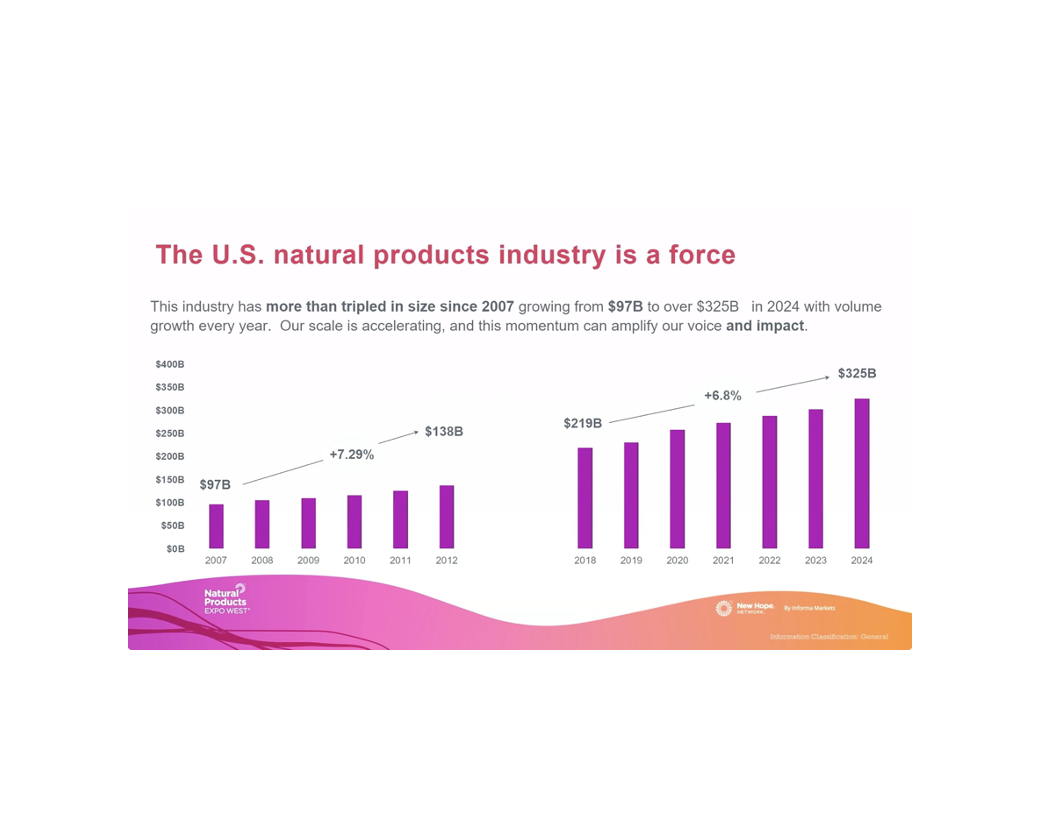
Natural and Organic Industry Is a Force
Overall, the natural and organic products industry combined has more than tripled in size since 2007, growing from $97 billion in sales in 2007 to over $325 billion in 2024, according to data compiled by New Hope Network, SPINS (a division of Nielsen), Whipstitch Capital and others, and presented at this year’s State of Natural & Organic keynote presentation at Natural Products Expo West, the world’s largest trade exhibition for the natural, organic, regenerative, nutritional and eco-friendly consumer products industry, held in March 2025.
“Wow, this industry is a force,” said Jessica Rubino, VP of Content & Summits for New Hope Network, at the keynote presentation. “That is a tremendous amount of growth. Today, we’re defining the industry as the natural, organic and functional food and beverage space, dietary supplements and personal care.” According to Rubino, the industry grew 5.7% in 2024, exceeding expectations. “The biggest piece of the pie is food and beverage, followed by dietary supplements and then personal care.” Rubino also said that while personal care is the smallest segment, it is the fastest growing and a category to watch.
“Natural products are absolutely continuing to accelerate again. Of course, they’re all outpacing non-natural products, and that’s even with not a whole lot of new items coming through,” said Kathryn Peters, Head of Industry Relations for SPINS and one of this year’s keynote presenters. “We’re also seeing more buyers coming in. This is being driven across many areas of the store, whether it’s refrigerated, grocery or vitamins and supplements. So, it’s just a resilient, wonderful story of growth we see in the industry. And really importantly, the game is continuing to be all about smart, profitable growth.”
In addition, “Organic is still very solid and strong, moving about the same pace as natural,” Peters said. “Consumers obviously have a strong awareness more than a lot of other certifications and a confidence in organic.” Certified regenerative products, too, showed significant growth of 20% in 2024, the panel noted.
“In just a little over two decades, the USDA Organic label has earned deep trust among consumers and has become one of the most identifiable food labels in our grocery stores,” said Matthew Dillon, Co-CEO of the OTA. According to OTA’s survey, more than half of U.S. consumers bought an organic fruit or vegetable in the last year. Consumers surveyed bought more bread in the last six months than any other food item, and 27% said they chose organic bread. For those surveyed consumers buying baby food, a whopping 93% chose organic. The USDA Organic label is particularly important for younger consumers, with over two-thirds seeking out the organic label in almost every food purchase. The Organic label was most valued in fresh food categories including fruits, vegetables, meat/poultry, baby food, eggs and dairy, and these items were the most likely products to be purchased as organic over the last 12 months.
Regenerative Agriculture Draws Investor Interest
In addition, regenerative agriculture — a system of farming that seeks to sequester carbon by rebuilding healthy soil — is among the sectors attracting more interest from impact investors, despite being an underfunded sector. However, there is growing consensus that the increasing threat to biodiversity is unsustainable and regenerative agriculture urgently needs to scale up. Now, groups such as Regenerative Food Systems Investors Forum and Impact Investor are drawing investor’s interest to the space.
One of the primary challenges to investing in regenerative food and farming is due to the fact that it requires significant upfront investment to transition from conventional farming. As such, many institutional investors remain hesitant due to uncertain returns and long payback periods. “This transition to regenerative farming is a long term one. That’s why intensive agriculture is so widespread, because it’s a very quick win. This is why you need investors to be patient and be willing to take some of the first loss and risk. This then accelerates the amount of private capital that will come in, because risk is protected,” said Harriet Jackson of responsAbility, a Swiss impact investing firm, speaking at Impact Investor’s 2024 conference in The Hague.
“Today…we are at what appears to be a crucial point in the transformation of agriculture and food systems. The momentum for regeneration is distinct,” said Sarah Day Levesque, Managing Director of Regenerative Food Systems Investment Forum, an investor’s organization seeking to build a more resilient food system. “There’s an increasing number of farmers pioneering the transition on the farm and increasing acreage. We can also see it in the incredible growth of organizations like EARA — the European Alliance for Regenerative Agriculture – designed to give rise to the voices of farmers in transition. Governments and public policy makers are acknowledging the very real risk presented by climate change and degradation of nature, including that caused by extractive agricultural practices. We are increasingly seeing policies and public sector investment that seeks to address these risks and support transition. Businesses and asset owners are starting to see and feel the importance of investing in nature and climate positive land use – seeing how critical investments in natural capital will de-risk production and create resilience in business models and investment outcomes.”
One organization seeking to foster investment in regenerative agriculture is the Boulder, CO-based Mad Agriculture, which in March 2024 launched Mad Capital, a $50 million investment fund aiming to de-risk regenerative and organic farming. With commitments from The Rockefeller Foundation, Schmidt Family Foundation and more, Mad Capital established its Perennial Fund II to provide loans to U.S. farmers to help them transition to regenerative and/or organic agriculture. The fund has made two closes and is “actively deploying capital to farmers,” said Mad Capital Co-founder and CEO Brandon Welch.
Natural and Organic Brands Are Outperforming
From an investor’s perspective, the overall natural, organic and regenerative products industry is looking better than it has in some time, asserted Nick McCoy, Managing Director and Cofounder of Whipstitch Capital, at the State of Natural & Organic keynote at Natural Products Expo West. “Over the last couple of years there’s been a lot of talk and a lot of pain for the lack of liquidity in this industry. It’s been very difficult for founders to find money compared to pre-Covid. Right now, we’re sitting in a very similar point as we were in 2010 or 2011 facing the millennial launch and emerging from the great recession…when it was very difficult to raise small checks. So, what's the hand of cards that we're playing in this industry now? Well, we have natural products that are very attractive. They're outperforming…consumers are running to them. We have positive ROI in cash invested. Cash invested is resulting in big revenue gains right now, and ultimately dollars chase dollars,” McCoy said.
“We may not have had as much M&A or fundings over the last two years, but…we've built a tremendous amount of value in this industry. And when you see more consumers spending more money in wellness, investment in M&A and other dollars eventually catch up and that's what's going to happen. CPG investors right now are sitting on a very large pool of illiquid but very attractive assets. There's a lot of viable brands that are growing faster than basically the broader market... Interest rates are starting to stabilize. We're seeing more fund closings and more investors getting more liquid money and the amount of illiquid value locked up is going up.”
According to McCoy, it’s not just the “big strategics" buying natural food brands. The natural products industry itself is seeing companies growing large enough to potentially become buyers themselves. “We’re seeing lots of talk about the IPO market starting again. Before 2021, I could probably count on one hand the number of brands that IPO’d in this industry. Now it sounds like it’s going to come back,” McCoy shared.
“There’re a lot of different ways that people get to liquidity,” McCoy added. “And once it does get liquid, then basically the money will flow from the bigger funds to the smaller funds, and the longer it takes, the more money these individual investors are going to get — surprising amounts. They thought they were going to get five times their money or 10 times their money investing in the company in 2015, and now it's grown so large they get 50X when it sells. And that's a true case of some that recently sold.”
According to McCoy, the $100-$300 million in revenue independent natural CPG brands — a group showing “tremendous growth” — represent major M&A and consolidation opportunity. “If we look at some of these recent high-profile deals, two, two and a half, three times revenue are where some of these things are trading. So, if we apply a two and a half times revenue multiple using SPINS sell-through data, you can see that this kind of locked up illiquid value that was $13 billion two years ago is up to $19 billion now. And when you think about a number like that, when that money starts to go back to investors, if you're an investor and you put $25,000 into a company expecting to get $250,000 and suddenly you get $1.5 million, you're going to be investing a lot more than $25,000 into other companies and that's going to bring the liquidity back over these next few years. It's really exciting to me.”
Resources
● The State of Natural & Organic — Keynote Presentation recorded at Natural Products Expo West 2025; watch here.
● Nutrition Capital Network — With news, resources, and events, NCN brings together active investors and innovative companies in health, nutrition and wellness,, www.nutritioncapital.com
● Whipstitch Capital — A leading investment bank tracking the food & beverage and health & wellness space, www.whipstitchcapital.com
● Big Path Capital — A leading investment bank and annual conference for impact investing and “Impact CEOs,” www.bigpathcapital.com
● MAD Capital — An investment fund for regenerative and organic ranchers and farmers, www.madcapital.com
● Regenerative Food Systems Investment Forum — An investor’s organization seeking to build a more resilient food system, www.rfsi-forum.com
Steven Hoffman is Managing Director of Compass Natural, providing public relations, brand marketing, social media and strategic business development services to natural, organic, regenerative and sustainable products businesses. Contact steve@compassnaturalmarketing.com.
Is 2024 the Year Regenerative Agriculture Takes Root?
This article first appeared in Presence Marketing’s January 2024 newsletter.
By Steven Hoffman
In 1942, J.I. Rodale first popularized the term organic in the U.S. with the launch of Organic Farming and Gardening Magazine. Some 45 years later, in the 1970s, J.I.’s son Robert Rodale introduced the phrase “regenerative organic.” Robert’s goal was to describe an approach to farming that combined organic practices with a more holistic approach to land management and a focus on rebuilding soil health. Yet it’s only been in the past few years that the term has gained more widespread traction.
With the release in 2023 of two full-length feature documentary films, Common Ground and Organic Rising, along with increased adoption among farmers and producers, awareness of regenerative agriculture is set to gain ground in the coming year among large-scale food manufacturers, policymakers, researchers, the general public and more. Today, advocates of regenerative agriculture say it is the best way to produce healthier food and promote local and rural economies. And, by sequestering carbon back into soils, it can also play a significant role in mitigating climate change.
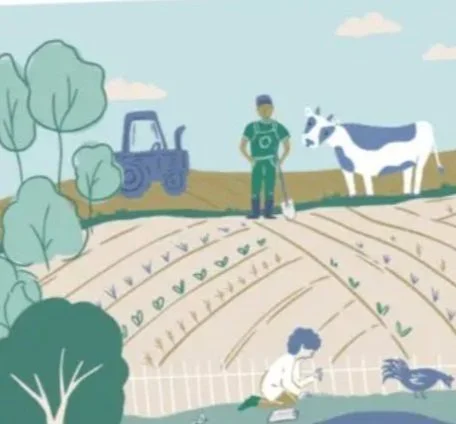
“2024 indeed will be marked as the year of regenerative agriculture. Why? We are closing in on a tipping point of awareness and collective action is being realized on a huge scale. Not only is soil and regenerative agriculture finally making its way as a leading climate, water and health solution, but we are also showing up as one of the biggest economic solutions for rural economies and businesses across the world,” said Finian Makepeace, Co-founder and Chief Strategy Officer of the nonprofit organization Kiss the Ground and Producer of the films Kiss the Ground and its sequel Common Ground.
“With the recent film Common Ground, and many other feature films and shows in this space sharing the story along with the incredible build of awareness brought on by Save Soil and others, we are seeing a dramatic increase in people comprehending the soil solution. With brands and businesses, there are huge commitments around regenerative agriculture for 2030. I believe 2024 will be a year of turning on those actions and increasing the integrity of their proposed programs. Regarding regenerative agriculture, I feel that 2024 will be the year that the world’s regen leaders find common ground and agree upon a definition that will allow for many more to work and support this space functionally,” Makepeace added.
“I do think that 2024 could be the best year yet for regenerative agriculture. While there is still disagreement over the definition, there is significant consensus that it includes a keen focus on building soil health, enhancing biodiversity, humanely integrating livestock and including worker fairness. New certification and verification programs like Regenerative Organic Certified, Certified Regenified, and Soil & Climate Health provide a lot of support and tools for farmers who want to incorporate more regenerative practices,” said Elizabeth Candelario, Director of Strategic Partnerships for MAD Agriculture, an organization that works with farmers and industry to advance regenerative practices.
In addition, Candelario said, “While their motivations may vary — from mission alignment to strengthening supply chains to mandatory ESG reporting — food companies are (finally) paying attention to the agriculture that is producing their ingredients. And food was finally on the table at the recent COP28 climate summit. The conference opened with a declaration on sustainable agriculture, signed by more than 130 countries, and ended with a final agreement that acknowledges for the first time that sustainable agriculture needs to be included in climate change solutions.”
Regenerative Products Sales Take Off
Now, the marketplace is responding. According to the Regenerative Organic Alliance Impact Report 2022 – 2023, sales of Regenerative Organic Certified (ROC®) products grew an average of 22% from EOY 2022 to EOY 2023, with sales totaling nearly $40 million in 2023. Companies including Dr. Bronner’s, Patagonia, Lundberg Family Farms, Manitoba Harvest, Bonterra and others are leading the certification efforts and serving as role models for other brands.
According to the Impact Report and based on SPINS data, revenue from sales of ROC® products in natural and multi-outlet grocers increased by one-third compared to the same period in the previous year. In addition, the number of ROC® SKUs in the market increased nearly forty-fold in 2023, “indicative of continued growth potential,” the report said. “By offering Regenerative Organic Certified products, brands are responding to the consumer desire to have their purchase make a positive impact at every level: environmentally, ethically, and socially,” the report concluded.
Globally, the market size for regenerative agriculture reached US$975.2 million in 2022, and is projected to be worth US$4.3 billion by 2032, poised to grow at a CAGR of 15.97% from 2023 to 2032, according to a June 2023 report from Precedence Research. North America generated more than 37% of the revenue share in 2022, Precedence Research reported.
While regenerative agriculture practices aren’t yet familiar to most Americans (just one in five consumers surveyed by Food Insight in 2022 said they’d heard of regenerative agriculture), 73% of consumers agreed they would be more likely to trust retailers and brands that implement regenerative agriculture programs, and 72% agreed that they would be more like to purchase from them, Supermarket Perimeter reported in October 2023.
Major retailers are taking notice. In December 2023, Whole Foods Market announced that it had implemented new standards to protect pollinator health. As such, the retailer will now require all fresh produce and floral suppliers to implement supply chain practices that help protect honeybees and other native pollinators.
Speaking to executives at Progressive Grocer’s Grocery Impact conference in November 2023, Whole Foods CEO Jason Buechle said, “Whole Foods Market invites you to help us start a ripple effect of change that will fix our broken food system. The decisions we make as a business — even the smallest ones — in how food is raised and grown today can have a profound and lasting impact on nourishing people and the planet for future generations to come. One of the biggest challenges our food system is facing now and will continue [to face] in the future is the climate crisis. If we continue farming in the large-scale, mechanized way that much of the industry currently does, our topsoil is not going to have the nutrient density it needs to grow the foods we know and love today,” Buechle said.
To address this challenge, Buechle reported that the retailer is working with farmers, ranchers, suppliers, scientists and other experts, as well as leading organizations, to leverage regenerative agriculture to evolve the practices used to grow, raise and produce the products that it sells. A focus on regenerative agriculture and responsible sourcing is an essential part of the retailer’s value proposition, which remains strong despite the mainstreaming of natural foods and the effects of inflation on consumer spending, according to Buechle.
Regenerative Food and Agriculture in 2024
In October 2023, Forbes reported that water stewardship will one of the biggest food trends in 2024. “As the tides of environmental consciousness continue to shape consumer choices, it is no wonder that water stewardship is set to become one of the top food trends for 2024,” wrote Senior Contributor Daphne Ewing-Chow.
“The global agri-food industry— valued at $6 trillion— is one of the most highly exposed to water risks, with water stress impacting many of the world’s largest food-exporting countries. Paradoxically, despite mounting perils to both food and water security stemming from water depletion, pollution, and climate-induced droughts, the food and agri-business sector is a chief contributor to the problem, accounting for a substantial 70% of all freshwater withdrawals,” she continued.
According to Ewing-Chow, “Regenerative agriculture plays a pivotal role in enhancing soil health, facilitating nutrient retention, bolstering natural resilience to environmental challenges, and mitigating erosion. This contributes to the conservation of water resources and the enhancement of ecosystem water quality, reducing the volume of water required for farming activities and decreasing harmful water and nutrient runoff from agricultural lands.”
Forbes also reported that in September 2023, SAI Platform, a network comprising 170 major food companies dedicated to sustainability, unveiled a global framework outlining the transition to regenerative agriculture for food businesses. A number of mainstream food brands such as Unilever, Nestlé, McDonald’s, Danone, and General Mills have already committed their support for regenerative agriculture, Forbes reported.
Greater technical innovation and research into regenerative agriculture will continue over the coming year, the Global Ag Tech Initiative predicted in its December 2023 report, 5 AgTech Trends to Watch in 2024. “Essentially mimicking natural process and biodiversity on agricultural land, the ultimate aim of regenerative agriculture is to improve soil health in order to boost yield. To address the challenges of climate change and feed a global population of over 8 billion, regenerative agriculture is vital. Digital tools use accurate, up-to-date data to create tailored regenerative agriculture solutions. These consider soil conditions, weather conditions, microclimates, and current crop growth or land use, as well as individual budgets and local regulations. Platforms offering site specific data will likely reign supreme in 2024. A view of sustainability that extends beyond simple carbon metrics and one-size-fits-all solutions is necessary and will enable the establishment of realistic, actionable objectives for growers, promoting sustainability and formulating strategies tailored to local environments,” the report said.
Beyond Food – Regenerative Fashion Threads the Needle
On the textile and fiber front, companies including fashion leader Mango will begin incorporating regeneratively grown cotton into its 2024 fashion collections, the Fashion Network reported in December 2023. The company has partnered with Materra, a British-Indian company specializing in regenerative cotton cultivation, and said it will be able to ensure complete traceability across the value chain of its cotton, from seed to final garment.
“As a global fashion company, our intent is clear: to contribute to creating a fairer society and reduce the fashion industry’s impact on the environment. This is why we ally ourselves with key partners like Materra, which will help us accelerate our path to ensuring that 100% of the fibers we use are sustainable by 2030,” said Andrés Fernández, Mango’s director of sustainability and sourcing.
Other fashion brands driving regenerative agriculture initiatives include J.Crew, Prana, Terra Thread and other textile and fiber companies that are members of the Regenerative Organic Alliance. “Big fashion brands and independent labels are embracing regenerative agriculture as a win-win solution that could allow them to source climate-positive materials. The challenge is that the concept doesn’t have a singular definition, and without clear standards it risks becoming a tool for greenwashing,” Business of Fashion reported in August 2023.
California Could Define Regenerative
Speaking of a definition, beginning in January 2024, the California Department of Food and Agriculture (CDFA), in collaboration with the State Board of Food and Agriculture, will host a series of public listening sessions to receive comments to help define “regenerative agriculture.”
“As interest in ‘regenerative agriculture’ continues to grow, we are seeing the introduction and evolution of the term in California policies and programs,” CDFA said. “Incorporating a definition of regenerative agriculture for state policies and programs provides a science-based criterion for the designation or recognition of the term ‘regenerative’ in agriculture-related policies of the state. By defining ‘regenerative agriculture’ and its associated practices, we are working to formalize holistic methods of farming that are designed to protect, sustain and enhance natural resources on our farms and farming communities throughout California,” the agency said.
Max Goldberg, Editor and Publisher of Organic Insider, commented, “If California codifies or legally defines ‘regenerative agriculture’ … it will certainly raise the profile of this term among consumers and farmers may end up paying more attention to the way they manage their soil, which is a real positive. However, both the opportunity for greenwashing and the consequences for organic could be severe,” he cautioned.
“At its core, the regenerative agriculture controversy stems from the question of whether a farming practice can be truly ‘regenerative’ if super-toxic chemicals, such as glyphosate or dicamba, are applied to the crops. There is no question that the regenerative movement has brought incredible attention to soil health … and that it has led to very important steps forward in farming practices around the world. But with all of the positive developments, ‘regenerative’ is ripe for abuse and greenwashing, and the multinational chemical companies, who have no intention of minimizing the importance of GMO seeds and synthetic pesticides, are eagerly embracing the term,” Goldberg added.
Elizabeth Whitlow, Executive Director of the Regenerative Organic Alliance, which manages the Regenerative Organic Certified program, told Organic Insider that she believes that California needs to act with real caution. “There are many groups and farmers advocating for ‘regenerative agriculture’ that are doing some excellent and extremely vital work. My concern, however, is that if the state defines ‘regenerative agriculture’ and it excludes organic, it could have the unintended effect of actually doing a lot more harm than good. Bad actors greenwashing the term is a real threat, and all stakeholders in California’s organic industry need to be fully engaged and on board with how the state is going to define ‘regenerative agriculture.’ The stakes are very high, for both California and our entire country, and this process cannot be rushed,” she said.
Woody Harrelson’s Regenerative Reason for Hope
Three-time Oscar nominated actor and environmental activist Woody Harrelson, in a December 2023 Op-Ed in The Wrap, expressed that, after serving as a co-narrator on the film Common Ground, he is “no longer hopeless for the future.”
Harrelson writes:
We stand at a crossroads, facing two paths. One leads to climate chaos, food shortages, deserts expanding and a biodiversity crash. The other involves rethinking our relationship with nature by choosing regenerative agriculture. The regenerative path can give us abundant, nutritious food, thriving ecosystems and a future for generations to come.
I had a surreal moment when I met King Charles and he said he loved “Kiss the Ground” so much he personally sent it to 1,000 people. I hope the same is true of “Common Ground” – I hope thousands of people send the new documentary to thousands of their friends.
I’ve never been a big believer in the political process in this country, but I believe in people. Congress is currently debating something called the Farm Bill. There are a lot of good people in America, who deserve to eat clean food, and it would be refreshing to see Washington prioritize communities over commodities.
I’m no longer hopeless. I’m actually inspired. In fact, I’m committed to using my voice and activism to make the regenerative agriculture movement spread far and wide.
We don’t just need to support soil in the Farm Bill — we need to make the effort in every way we can, from turning our lawns into food gardens and our food waste into compost, to buying food from local regenerative farmers and ranchers. We all eat and we can all support the people who are doing the hard work to feed the world with healthy regenerative food. We can vote with our dollars.
One thing is for certain, it’s time for a change. Soil is our common ground.
Let’s make regenerative agriculture our priority.
Learn More
Growing Life: Regenerating Farming and Ranching, by André Leu, December 2021
Food Climate and Nature FAQs, The Nature Conservancy, Sept. 1, 2023
Regeneration International, a global nonprofit organization and educational resource
44th Annual EcoFarm Conference, Pacific Grove, California, Jan. 17-20, 2024
Regenerative Business Live, United Nations, New York, NY, May 7, 2024
Steven Hoffman is Managing Director of Compass Natural, providing public relations, brand marketing, social media, and strategic business development services to natural, organic, sustainable and hemp/CBD products businesses. Compass Natural serves in PR and programming for NoCo Hemp Expo and Southern Hemp Expo, and Hoffman serves as Editor of the weekly Let’s Talk Hemp Newsletter, published by We are for Better Alternatives. Contact steve@compassnaturalmarketing.com.

Natural Foods CPG Entrepreneur Moves to Empower Farmers – GoodSAM’s Heather Terry Joins Compass Coffee Talk, Oct. 19, 2022, 11:30 am ET

Natural Foods CPG Entrepreneur Moves to Empower Farmers – GoodSAM’s Heather Terry Joins Compass Coffee Talk,
Oct. 19, 2022, 11:30 am et
LEADING PODCAST COMPASS COFFEE TALK WELCOMES HEATHER TERRY, FOUNDER AND CEO OF GOODSAM FOODS, FOR A DISCUSSION OF REGENERATIVE AGRICULTURE, THE IMPORTANCE OF SUPPORTING FARMERS, DIRECT TRADE, AND HIGH STANDARDS FOR COFFEE AND CHOCOLATE
WEDNESDAY, OCT. 19, 2022, 11:30 am ET
ZOOM, Admission Is Free


Heather Terry, founder and CEO of GoodSAM Foods
Compass Coffee Talk™ continues its live webinar series for entrepreneurs and business leaders in the natural, organic and sustainable products industry by welcoming Heather Terry, founder and CEO of GoodSAM Foods, a public benefit corporation and a rapidly growing brand in the natural and organic products channel.
In the popular podcast, hosted by natural products veterans Steven Hoffman and Bill Capsalis, Heather will share how GoodSAM is “doing well by doing good,” leading the way in regenerative agriculture and consciously sourced consumer products, with vertically integrated product lines in coffee and chocolate sourced from sustainable partner farms.
Heather brings a career’s worth of experience to the GoodSAM venture, with a mix of entrepreneurial forays, such as NibMor Chocolate, and work as a consultant who grew many natural beauty product brands such as S.W. Basics, Pulp Pantry and Organic Bath Company, among others.
Today, Heather is focused on working with farmers to ensure they are paid fairly and the material is ethically sourced for all of GoodSAM’s direct trade products.
“It seems small, picking up snacks or coffee for your everyday, but when you buy those things from GoodSAM, you are doing so much more,” states Heather on the GoodSAM website (www.goodsamfoods.com). “You are enjoying a high quality product with health benefits, you are paying farmers and families a living wage, you are contributing to reversing climate change because of our and our partners’ sustainability practices. It’s all circular and it is the reason I love getting up in the morning to do my job.”
“Certain individuals make a big difference, and they influence and inspire others with not only good business sense, but also a strong sense of mission, leadership and service. Heather Terry is one of those people. Tune in to learn more about Heather and how her story can apply to the success of your business,” said Steven Hoffman, managing director of Compass Natural and co-host and producer of Compass Coffee Talk.
Register here for Compass Coffee Talk with Heather Terry
Register here to participate in the upcoming Compass Coffee Talk, Wednesday, Oct. 19, 2022, 11:30 am – noon ET
About Heather Terry
Heather Terry is the founder and CEO of GoodSAM Foods, a public benefit corporation (PBC). She has been a CPG mentor and an angel investor and is the author of From Broadway to Wall Street. In addition, she is a partner and the former chief strategy officer of BeyondBrands, a leading consulting agency focused on natural products. For more than a decade, Heather has been immersed in the consumer-packaged goods vertical, first as the co-founder of NibMor Chocolate. She also has worked to expand popular clean beauty and wellness brands, including S.W. Basics, Pulp Pantry and Organic Bath Company. She has secured for her wellness clients coveted spots on the shelves of national retailers such as Whole Foods Market and Target. She has also been featured at WELL Insiders, WELL Summit, The Wild Rose Collective, the Rising Women Conference, Loyola University, Good Housekeeping’s Raise the Green Bar Summit and the Regenerative Rising Summit.
Heather is a graduate of the International Culinary Center in New York and received an MFA from Rutgers University. She is pursuing a degree in permaculture and is passionate about direct trade and regenerative agriculture.

About Compass Coffee Talk™
Take a 30-minute virtual coffee break with Compass Coffee Talk™. Hosted by natural industry veterans Bill Capsalis and Steve Hoffman, Coffee Talk features lively interactive conversations with industry leaders and experts designed to help guide entrepreneurs and businesses of any size succeed in the market for natural, organic, regenerative, hemp-derived and other eco-friendly products.
Compass Coffee Talk™ is produced by Compass Natural Marketing, a leading PR, branding and business development agency serving the natural and organic products industry. Learn more.
VIEW OUR PAST COMPASS COFFEE TALK EPISODES ON YOUTUBE.


Family for Change: Tom Newmark and Sara Newmark Talk Regenerative Ag, Purpose, Climate, Business, and More on the Next Compass Coffee Talk


Tom Newmark (Left) and Sara Newmark (Right)
Compass Coffee Talk will get 2022 off to a bold start with a powerhouse duo sharing business wisdom and mission-focused inspiration on January 12, 2022, at 11:30 am Eastern time. Natural industry legend Tom Newmark brings a long record as a pioneer and leader in natural, organic, and regenerative business, as well as a deep and active commitment to climate-focused education and advocacy. Sara Newmark, chief operating officer at True Grace, a nutrient-dense supplements company, carries on the family tradition of advocacy, responsible business leadership, and service, while raising two kids on an organic and regenerative farm with her husband.
About Sara Newmark
A strong community and social impact professional, Sara Newmark is the COO at True Grace, a new brand of nutrient-dense supplements formulated to improve the health of body and planet for generations to come. An experienced executive with a demonstrated history of working in the health and wellness industry, Sara is an advocate for the power of business to make lasting, systemic change. She brings diverse experience and leadership in sustainability to the True Grace team where she works to improve the health of communities, farmers, people, and planet by committing to doing business regeneratively.
Sara is board co-chair for Green America and sits on the boards for the Coalition for Supplement Sustainability and The Retreat Farm. She lives in Vermont on a 10-acre organic and regenerative farm with her husband and children. The Newmark family also owns Finca Luna Nueva, an eco-lodge and teaching center for regenerative agriculture in Costa Rica.
About Tom Newmark
Tom Newmark is a member of the Leadership Council of the Center for Regenerative Agriculture and Resilient Systems at California State University, Chico and co-owner of Finca Luna Nueva, an eco-lodge and regenerative farming operation in Costa Rica. Tom is co-founder and chair of The Carbon Underground, co-founder of Regeneration International, past chairman of the Greenpeace Fund USA and the American Botanical Council, and founder of Sacred Seeds, a plant conservation project administered by United Plant Savers. As CEO of New Chapter, Inc. he helped to align that company with the goals of the NonGMO and organic movements.

About Compass Coffee Talk™
Take a 30-minute virtual coffee break with Compass Coffee Talk™. Hosted by natural industry veterans Bill Capsalis and Steve Hoffman, Coffee Talk features lively interactive conversations with industry leaders and experts designed to help guide entrepreneurs and businesses of any size succeed in the market for natural, organic, regenerative, hemp-derived and other eco-friendly products.
Compass Coffee Talk™ is produced by Compass Natural Marketing, a leading PR, branding and business development agency serving the natural and organic products industry. Learn more.
VIEW OUR PAST COMPASS COFFEE TALK EPISODES ON YOUTUBE
Pepsico Announces Goal to Expand Regenerative Farming Practices on 7 Million Acres by 2030

This article originally appeared in Presence Marketing’s June 2021 Newsletter
Pepsico announced in late April that the company is launching an ambitious, impact-driven “Positive Agriculture” strategy with the goal of spreading regenerative agriculture practices across 7 million acres of farmland by 2030, which the company says is approximately equal to its entire agricultural footprint.
“Any plan to tackle the urgent challenges facing the global food system must address agriculture, the source of nourishment for billions and a key lever to address climate change and inequality,” said PepsiCo Chairman and CEO Ramon Laguarta.
Pepsico estimates the initiative will eliminate at least 3 million tons of greenhouse gas emissions (GHG) by the end of the decade. Additional 2030 goals within its Positive Agriculture agenda include improving the livelihoods of more than 250,000 people in its agricultural supply chain, and sustainably sourcing 100% of its key ingredients, the company said.
“One big part of Positive Agriculture is extending regenerative farming practices — a set of techniques that improve and restore ecosystems with a focus on building soil health and fertility, reducing carbon emissions, enhancing watershed management, increasing biodiversity and improving farmer livelihoods. Partnering with farmers, PepsiCo will spread the adoption of these practices across 7 million acres, approximately equal to the company’s entire agricultural footprint. The growers behind products like Lay’s potato chips, Quaker oats and Tropicana orange juice will be driving forces,” the company said.
“Today, we're accelerating our Positive Agriculture agenda, because we know we have to do even more to create truly systemic change,” said Jim Andrew, PepsiCo’s Chief Sustainability Officer. “By focusing on regenerative agriculture practices at the local level to build soil health, we can build a stronger foundation for our products and help make the entire food system more sustainable.”

Join Robyn O'Brien and Pam Shepherd on Compass Coffee Talk, June 16, 2021, 11:30am EDT

Financing the Transition to Regenerative Agriculture
Food Industry Icon Robyn O’Brien and Finance Expert Pam Shepherd Discuss the Future of Organic and Regenerative Farming on the Next Compass Coffee Talk™, Wed., June 16, 2021
Wednesday, June 16, 11:30am - Noon EDT
Zoom, Admission is Free


Robyn O'Brien (Left) and Pam Shepherd (Right)
Get the latest dirt on why soil is the future and hear from rePlant Capital’s Co-founder and Managing Director Robyn O’Brien, alongside finance expert Pam Shepherd, Managing Director, Manna Tree Partners.
Robyn O’Brien has been called “food’s Erin Brockovich” by the media and is globally recognized for her voice in the industry. At rePlant Capital, O’Brien diligently works to reverse climate change through the deployment of a series of proprietary funds focused on U.S. farmers. On Compass Coffee Talk, she will share her perspective on the future of organic farming and how financing plays a part in transitioning American farmland to regenerative and organic agriculture.
Also joining Compass Coffee Talk is Pam Shepherd, who brings 18 years of financial, transactional, and operational expertise to Manna Tree Partners, an investment firm dedicated to improving human health through nutrition with forward-thinking strategies that make a global impact.
About Robyn O’Brien
Internationally acclaimed by the New York Times and Bloomberg, Robyn O’Brien was recently recognized by Forbes Magazine on its Impact 50 List for her work in food and agriculture. O’Brien’s TEDx talk (based on her book, The Unhealthy Truth, Random House) exposes the shortcomings in the food system. It has been watched by millions, translated into dozens of languages, and influenced policy, legislation, and product formulation in the food industry.
Prior to founding rePlant Capital, Robyn advised CEOs and executives at multinational CPG companies, startups, and farm organizations and worked on a team managing $20 billion in assets.
About Pam Shepherd
Pam Shepherd, Managing Director, Manna Tree Partners, spent eight years in investment finance, on the buy-side as a Vice President at Greenmont Capital Partners, working with healthy living companies like Eco-Products, Madhava, and EcoSmart. She also worked on the sell-side at St. Charles Capital, where she closed over $300 million in total transaction value. Most recently, Pam served as the COO and CFO of The Boppy Company for six years, a global consumer products company supporting mothers.
As a former operator, Pam has a deep understanding of the challenges faced by growth-stage companies. In addition, as a former investor, she understands how to best drive and support shareholder value creation for Manna Tree investors.

About Compass Coffee Talk™
Take a 30-minute virtual coffee break with Compass Coffee Talk™. Hosted by natural industry veterans Bill Capsalis and Steve Hoffman, Coffee Talk features lively interactive conversations with industry leaders and experts designed to help guide entrepreneurs and businesses of any size succeed in the market for natural, organic, regenerative, hemp-derived and other eco-friendly products.
Compass Coffee Talk™ is produced by Compass Natural Marketing, a leading PR, branding and business development agency serving the natural and organic products industry. Learn more.